


English
Dorothy K. Gordon gives a speech to introduce our Yidan Prize for Education Development Laureate at the 2025 Yidan Prize Awards Ceremony

11 Dec 2025

Dorothy K. Gordon
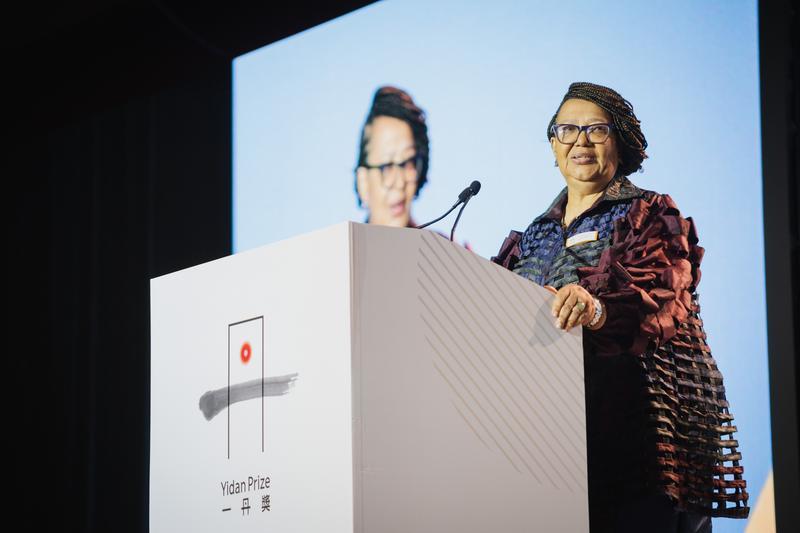

Esteemed guests and colleagues, my warmest greetings to all of you.
It is my honor to introduce the 2025 Yidan Prize for Education Development Laureate, Mamadou Amadou Ly, and the work of the team at Associates in Research and Education for Development ARED based in Senegal.
Globally, over a quarter of a billion learners cannot access education in the language they know best. The areas where they live are the areas where we see consistently poor levels of educational achievement.
Take your minds back to those first days of sitting in a classroom. Some of you may remember the adult figure in front of you talking to you in a language you do not understand. Paying attention to that stream of unintelligible sounds is a barrier many children fail to overcome. They hit the wall and bounce away, contributing to high drop out rates and low literacy levels with real consequences for economic growth and sustainable development.
West Africa, is a region rich in language and cultural diversity. Yet many schools only teach in a language many students don’t speak when they arrive at school, a language which their parents do not understand. A language foreign to their community and culture.
Mamadou Amadou Ly’s leadership at ARED is helping to eliminate this major barrier by aligning classroom experience with linguistic and cultural relevance.
ARED interventions encourage active participatory learning as children acquire foundational skills in their own languages. In Senegal, students start learning in a familiar national language. Then French is introduced, and they go on to learn in both languages. These programs are co-constructed with community members, national specialists, educators, and linguists — making sure the content is engaging and culturally adaptable.
In this way, the team develops, scales, and refines cost-effective bilingual education models for mainstream schools, remedial programs, and adult learners.
The impact on learning outcomes has been swift and remarkable.
The Ndaw Wune (‘Success For All’) Accelerated Learning Program is just one example.
This remediation program for struggling second- and third-graders at risk of dropping out, takes place both in and after school.
In a single year, students improved their reading by almost double in letter recognition, double in syllable reading, and more than double in word reading. This is the power of an equitable and linguistically inclusive system.
These results are echoed in studies showing the effectiveness of multilingual education globally.
Many demonstrate an impressive return on investment. ARED’s partnership with the Ministry of Education in Senegal has grown consistently from a 2008 pilot till today. It plays a strong supporting role in national educational reforms and the integration and use of national languages in the curriculum as part of the National Education policy. This work contributes to documented improvements in foundational literacy and mathematics in Senegal.
ARED models and learning materials are now being used in schools in the Gambia and in Mauritania. The potential for scale is immense as materials are openly licensed, which means they can be adapted, reused, shared, and are available to be used by everyone.
This collaborative listening approach and willingness to openly share the knowledge gained by ARED’s interventions has contributed to Mamadou Ahmadou Ly’s influence as a leader. It is demonstrated in close collaborations with governments, NGOs, IGOs, linguists, teachers, and community members.
Mamadou Amadou Ly, thank you for reminding us all of the importance of harnessing local expertise to deliver sustainable change within our communities by giving every child and every adult the opportunity to enjoy learning in the language with which they are most familiar. You and the ARED team offer us a powerful and adaptable model that opens lifelong paths for learning globally.
I am truly privileged to congratulate you on becoming the 2025 Yidan Prize for Education Development Laureate.
Thank you.
——
Dorothy K. Gordon
Head, Judging Panel, Yidan Prize for Education Development;
Board Member, UNESCO Institute for Information Technologies in Education

Share the blog with others


