


English
Reframing human capital: how we can think better and live better through education

20 Apr 2026

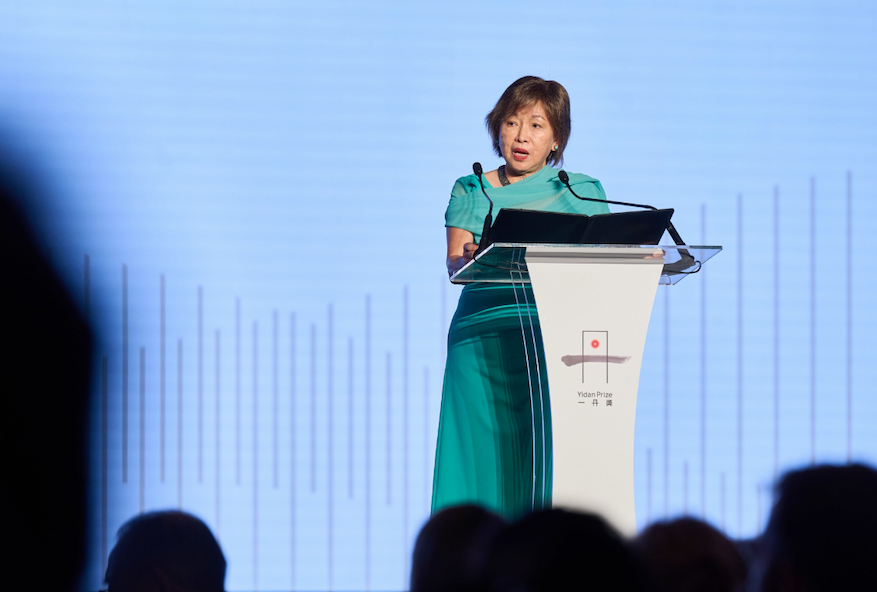

“My parents’ mantra was ‘do your best and be useful.’ And I think that’s what I’ve tried to be throughout my life.”
Speaking to our Education Research judging panel head, Elizabeth King, it’s striking how she brings clarity to a complex world by looking at it with compassion. As an economist, she spent most of her career shaping the World Bank’s approaches to education strategy and human development research. Yet behind the deceptive simplicity of that mantra is exactly the steadfast determination and pragmatism it takes to lead organizations through real, lasting change.
Elizabeth, better known to her colleagues as Beth, describes how her kindergarten teacher was pivotal in helping her find her voice and use it. Growing up in the Philippines, she recalls: “I didn’t want to stand up, even when I knew the answer to a question.” Noticing that shyness, her teacher started to gently push Beth into the spotlight — calling her up for role-playing and public speaking. “My teacher just wanted me to stand in front of the class and to experience what that’s like.”
“Teachers who care about students are important, and you want teachers who are smart and understand their students,” she explains. That pattern of thoughtful mentorship repeated throughout her education. Beth credits one particular teacher in her high school, Sister Victricia, with inspiring her early curiosity about poverty, development, and economics.
“She took a handful of us girls to the nearest slum area to our school. I had never been in one before. I knew slum areas existed, but I grew up in a more protected home.” After that eye-opening experience, Beth started volunteering every Saturday in orphanages, youth delinquency centers, and women’s mental health wards throughout her high school years.
Along with attending an all-girls school, these experiences shaped her understanding of the barriers to reaching one’s potential, especially for women. Over time, she’s seen the frontier move from getting girls into school and keeping them there to tackling the “horizontal segregation” that, for example, steers girls away from STEM fields in higher education or jobs even when they excel.
Part of that, Beth believes, is giving girls the kind of opportunity she had to observe strong role models. “It was wonderful to be taught by women who could have been anything they wanted to be. And I developed a deep respect for my classmates, who were pretty competitive and outspoken leaders. It made me realize how powerful girls and women are.”
Drawing on the work of Yidan Prize laureate Professor Carol Dweck, Beth sees the importance of a growth mindset. “The absolute saddest thing is to see young girls and boys not believe that anything could make them smarter, know more, do more, and have a better life. One of the challenges for teachers is to build in students the belief that staying in school, doing their best, is going to make them smarter and more able, more fit for life after school.”
And that life after school, as Beth knows first-hand, can look very different for women. When she began her work at the World Bank, she stayed in a research role for a long time because it was easier to control her travel, work from home, and spend time with her children — nurturing their growth and investing in them as her parents did with her. Caring responsibilities, which fall disproportionately on women, come at a cost for them, while benefiting their family, community and society as a whole. “Women are building the human capital of the next generation, which is a contribution to society that’s often hidden from policy.”
This is, clearly, an economist’s view of the world. And that’s a topic Beth quickly warms to, debunking ideas that economics is all about money. “It’s about decisions, behaviors, and motivations. It’s about how we manage our resources — and that includes time, energy, social relationships, social capital, political capital. Economics is about how to use these resources in the best possible way, so we can make life better.”
For Beth, both economics and education come down to our individual and collective well-being — a concept that, perhaps unsurprisingly, resonates deeply with her roots. “The Philippines and Indonesia ranked highly in a recent study of human flourishing,” she points out. “And I think that’s because they place a high value on relationships — both of the nuclear family and extended family and neighbors.”
That was the model demonstrated to her by her own parents, who never pushed her towards a particular career but instead encouraged her to give her all and give back. And if you ask her how to get to that point of flourishing, there’s a clear and simple answer. “Education. It’s what prepares us to live better and be better.”
About Dr Elizabeth M. King
Beth leads the Judging Panel for the Yidan Prize for Education Research. She is currently a Non-resident Senior Fellow of the Brookings Institution, Commissioner of 3ie, Global Board Member of Room to Read, Managing Editor of the Journal of Development Effectiveness, Adjunct Professor at Georgetown University, Visiting Professor at the University of the Philippines School of Economics, and Technical Adviser to Echidna Giving.
At the World Bank, where she spent most of her professional career, as global director for education, she was the senior spokesperson and professional head for policy and strategic issues related to education, acting vice-president for human development, and research manager for human development sectors. She has published journal articles, books, and book chapters on development topics such as poverty, education, labor markets, the care economy, and gender inequality. She has operational and policy experience in several developing countries worldwide. She received her PhD in Economics from Yale University.

Share the blog with others


