


English
Bruce Au delivers closing remarks at Seoul Conference

24 Jul 2026

Bruce Au, Secretary-General, Yidan Prize Foundation
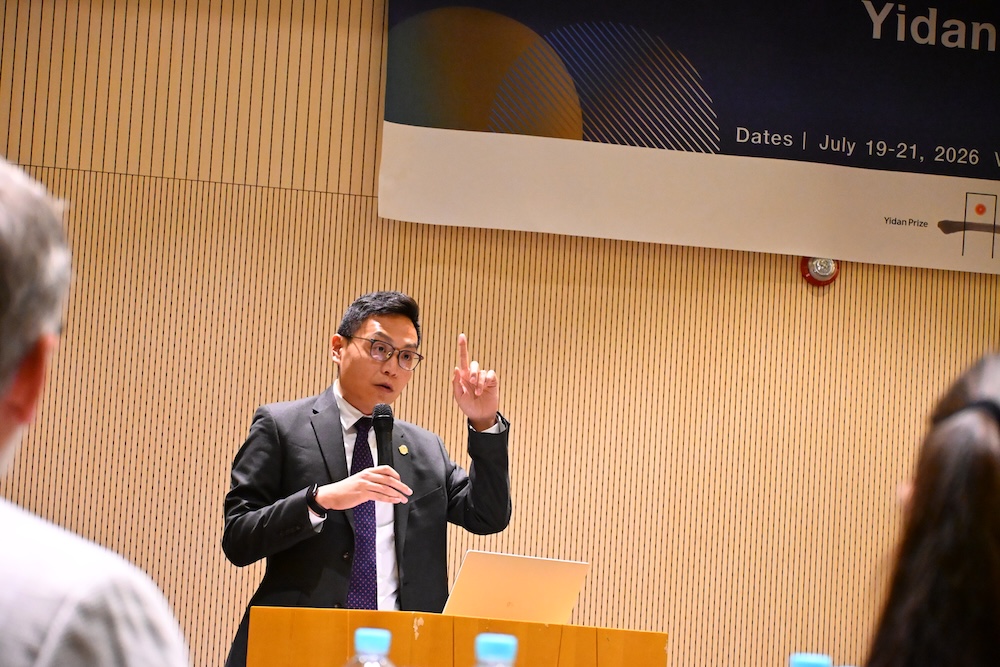

Friends, colleagues — thank you for a remarkable day.
Before I say anything else, let me first acknowledge where we are — and who we are. We are in Seoul, next door to IMPS. That means this room holds something rare: the people who do the science sitting beside the people who influence the systems. This particular room, in this particular year, stands in front of the largest open opportunity in education research in a generation. By the end of my remarks, I will ask you to do something — with pen and paper — before you leave this room.
Let me begin with a confession. Before I joined the Yidan Prize Foundation, I was a founding director of Character Lab, which Professor Angela Duckworth from University of Pennsylvania built. I had a front‑row seat to the grit phenomenon.
Carol Dweck — the originator of growth mindset — is our inaugural Yidan Prize for Education Research Laureate, an honor she earned many times over. Grit and growth mindset were two of the most electric ideas education has produced in the past quarter century. TED Talks with tens of millions of views. Bestselling books. Superintendents in America who could recite the definitions from memory.
SEL, for all its imperfections, traveled further into actual schools — because it arrived with frameworks, teaching practices, curricula, district scaffolding. It had infrastructure, not just insight. But SEL, too, has now run its course. It not only became politically contested but also hit a ceiling.
Let me call out that ceiling explicity — because that ceiling is the opportunity. SEL, like EQ before it, like grit and growth mindset, is fundamentally individualistic. It locates capacity inside one child’s head. It asks the child to regulate, to persist, to reframe — alone. Even empathy, in the EQ tradition, is something I possess, rather than something that exists between us.
Coming back to the large open opportunity I mentioned earlier. John Dewey wrote against the factory model of schooling in the 1930s. He saw, with total clarity, that a system built to produce standardized cognitive output was malnourishing the social organism of the classroom.
And then — structurally — not much changed. It took nearly fifty years before Howard Gardner, in 1983, mounted the potent challenge to the IQ hegemony. Then, another decade before Salovey and Mayer gave emotional intelligence a scientific formulation, and Goleman gave it wings.
There are windows when the field gets to redefine what intelligence means. They do not open often. I believe one is open now. For two reasons everyone in this room already feels.
First, as Elizabeth King said AI has done to the factory model what a century of critique could not. It has removed the model’s economic justification. When machines produce standardized cognitive labor, a school designed to produce standardized cognitive labor is not merely joyless — it is obsolete on its own terms.
Second: the relational recession. Here in Korea, the government literally pays young adults stipends to leave their rooms. The problem stream and the solution stream are converging. And the political stream — ministers, finance ministries, multilaterals — is searching for a frame.
The frame, I believe, is relational. Professor Park started us on the three domains and a system layer that characterize Relational Intelligence. Dr Kim mapped the sketch with existing bodies of research. Dr Gross extended the SEL framework. The concept will certainly evolve and strengthen.
I want to recognize someone here. Isabelle Hau has been developing the concept of relational intelligence — RQ. What impresses me is not the ambition. Education never lacks ambitious ideas. What impresses me is the discipline. She has resisted selling RQ as a finished product. Instead, she insists on scientific investigation across three distinct levels. This three‑level architecture is why relational intelligence can escape the individualistic ceiling that capped EQ and SEL.
1. Individual relational capacity.
The ability to build trust, navigate rupture and repair, create meaning with others. Related to EQ — but the unit of analysis is the bond, not the person.
2. Relational health.
A whole‑school, whole‑organization frame. Not “does this child have skills?” but “does this institution create the conditions?” Something a principal can implement. Something a hospital can accredit. Our medical education colleagues will recognize the parallels — continuity of care, psychological safety, team performance.
3. Relational infrastructure.
A systems frame that speaks the language of finance ministries. Measurable. Investable. Degradable. Renewable. The frame that turns a moral cause into a budget line. Individual. Institutional. Systemic. Skill. Health. Infrastructure. That is a research and development agenda.
Some of you have already alluded to the honest gap. The RQ research and development agenda today has no Salovey and Mayer equivalent. No seminal paper. No consensus definition. No validated ability measure. No agreement on whether the psychometric unit should be the individual, the dyad, the classroom network, or the institution. Measuring a property of the space between people is genuinely hard. It will require network psychometrics, modeling, cross‑cultural validation, and possibly methods that do not yet exist.
But consider what EQ teaches us. Salovey and Mayer published in 1990. Goleman popularized in 1995. The popularization outran the science so fast that the field spent twenty years repairing credibility. With RQ, the absence of a canonical paper is not a weakness. It is an opportunity not to repeat past mistakes. Measurement before marketing. Construct validation before curriculum sales. Registered claims before TED Talks. We can do it differently this time.
Here is what I would like to propose: No later than early December this year, we will convene a working group on Relational Intelligence, with a three‑year mandate. Its charge is simple in language, ambitious in scope: to birth the Salovey‑Mayer moment for RQ — the canonical construct definition — while building the evidence discipline EQ never had.
The Working Group will:
- Steward definitional work across all three levels
- Coordinate measurement development
- Set evidence standards — what claims may be made, at what confidence, and when
- Connect the science to programs and pilots on the ground.
No university can do this alone. The Yidan Prize network may be the only table where all the necessary chairs already exist. Professor Ju-Ho Lee and our laureates open ministerial doors. UNESCO steers the post‑2030 monitoring agenda — imagine relational indicators considered alongside proficiency metrics. UNICEF reaches frontline educators in the majority of the world’s countries. A construct validated only in Palo Alto and Seoul is not a construct. Our medical education colleagues can test relational health where stakes are life and death. Our Korean industry partners can help us answer the technological questions honestly — especially around data governance. Measuring children’s relationships wrongly is worse than not measuring them at all.
Before 2029 ends, we can aim for these five things to exist that do not exist today:
- A canonical, contestable, published construct framework — RQ’s 1990 paper.
- An open, cross‑culturally validated measurement toolkit at all three levels.
- Whole‑school relational health pilots in at least three regions, with preregistered designs.
- At least one government and one multilateral report carrying a relational indicator.
- A public claims register — stating what we know, what we suspect, and what we merely hope.
That is the agenda. It is too big for any one of us — but possible for all of us.
On your table is pen and paper. Before you leave, I ask you to write two things: First: what you are willing to do. Second: what you want others to do. Name names if you wish. The gaps you name become the panel’s assignments. We will read every card. The Working Group will be shaped by what you write in the next few minutes.
Dewey saw the problem in the 1930s. The field waited fifty years for Gardner. Gardner opened the door. The field waited a decade for measurable constructs. More than 35 years have now passed. We have another chance to redefine intelligence. We have a concept whose time has come. A scientific community with the tools to do it right. A global network with the reach to make it matter — and the wisdom to avoid repeating old mistakes. The 20th century measured how well children compute. Whether the 21st learns to measure how we connect meaningfully — that is not a question for history. It is a question for you. Write well.
Thank you — and thank you, Seoul.

Share the blog with others


