


English
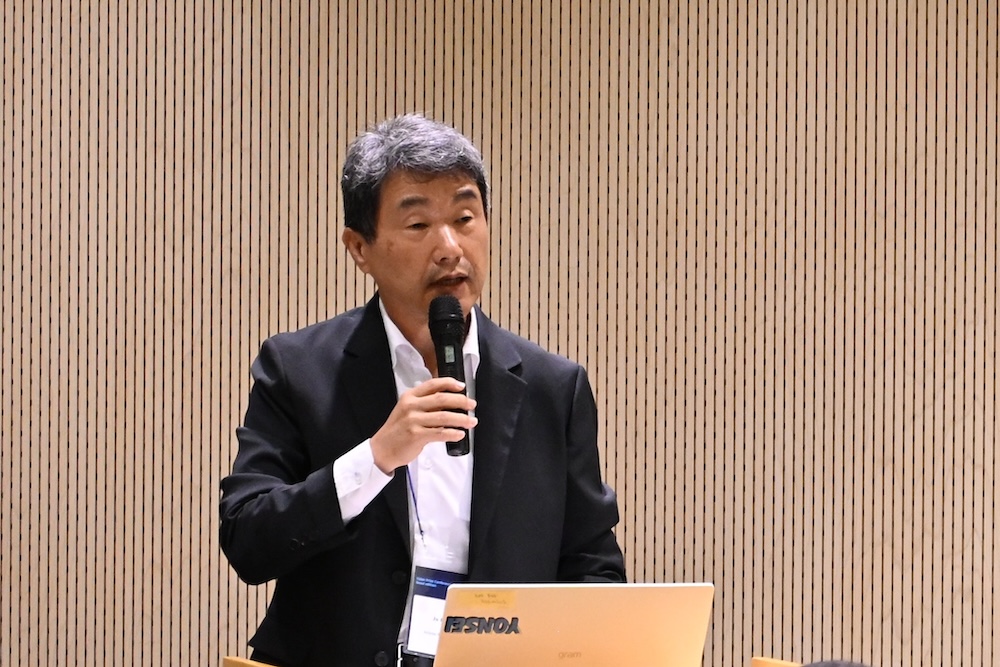
Professor Ju-Ho Lee gives opening remarks at Seoul Conference

24 Jul 2026

Professor Ju-Ho Lee, Professor of Practice, Mary Lou Fulton College for Teaching and Learning Innovation, Arizona State University

Good afternoon, everyone.
During my two terms as Korea’s Minister of Education, one of the most difficult challenges I faced was the very issue we are discussing today: how to measure relational intelligence, human connections, and socio-emotional capacity, and how to use that information to coach and teach students within a public school system.
Korea is a country that arguably asks its students to master some of the most demanding STEM curricula and university entrance examinations in the world. While this has often been admired internationally, it has also produced a huge unintended consequence.
Qualities that are equally important — relational intelligence, human connections, empathy, and socio-emotional development — have too often been pushed to the margins of education.
Today, in the age of AI, this is no longer just a Korean challenge. The degree may vary from country to country, but it is rapidly becoming a universal challenge. As AI becomes increasingly capable of performing cognitive and analytical tasks, the uniquely human capacities that connect us to one another become even more important.
That is why I believe the time has come to launch a global educational movement dedicated to finding solutions to this challenge together.
Co-convening the conference with the Yidan Prize Foundation is not a coincidence. The work of the Yidan Prize laureate community has long embodied the concept of relational intelligence, showcasing the rigorous science behind human connection.
Their work in psychology, developmental cognitive neuroscience, and the learning sciences reminds us that human connection is an essential foundation for learning, resilience, and flourishing.
So, how can we measure, coach, and teach human connections?
I do not claim to have all the answers. But I would like to share five ideas that have shaped my own thinking.
First, I believe we need to ask why we have struggled for so long to measure none-cognitive capacity like human connections.
Perhaps we have relied too heavily on teachers' subjective observations and self-report surveys. While these approaches have value, they have often failed to produce assessments that parents, students, and even teachers themselves fully trust.
I also wonder whether we have approached none-cognitive capacity with the wrong mindset.
In mathematics or science, it often makes sense to compare students along a single scale — from higher to lower performance. But should we expect none-cognitive capacity to work in the same way?
What if the qualities we care about most are inherently multidimensional?
One student may excel in empathy. Another may demonstrate exceptional teamwork. A third may show remarkable resilience or leadership.
Instead of saying that one student scores 95 and another scores 60, perhaps we should identify each student's unique profile of strengths and areas for growth.
If that is true, then our goal should not be ranking students. Our goal should be helping every student grow.
In other words, when assessing none-cognitive capacity, perhaps we should move away from summative assessment toward formative assessment — assessment that informs coaching, guides teaching, and supports continuous development.
I believe the time has come for us to seriously rethink these fundamental assumptions.
My second point is that AI gives us an unprecedented opportunity to assess human connections far more effectively than before.
Whether through AI-powered virtual reality, immersive simulations, or Ambient AI that observes learning interactions naturally, I believe we are entering a completely new era.
Ten years ago, AI surpassed the world's greatest Go masters. Today, AI is helping scientists solve problems that even Nobel laureates find extraordinarily difficult.
Of course, the quality of AI assessment will depend heavily on the quality of the data we collect.
But I would like to point to an inspiring example from medical education.
Many medical schools already use standardized patients — professional actors trained to play patients — to evaluate whether medical students communicate with empathy, build trust, and care for patients as human beings.
This has become an accepted way of assessing human interaction.
Now imagine what AI could make possible.
Could AI evaluate those interactions even more consistently than human actors?
Could AI simulate thousands of realistic social situations and provide detailed feedback that would be impossible to generate manually?
If AI can do this in medical education, why couldn't it do something similar in K-12 education?
Could AI observe how students collaborate during project-based learning, how they communicate with teammates, how they resolve conflicts, or how they support one another?
I do not expect AI to produce perfect measurements.
But perfection should not be the standard.
If AI can provide teachers with reliable, meaningful information about each student's human connections, that information alone could become an enormously valuable resource for coaching and teaching.
Third, if we hope to bring the assessment and coaching of human connections into K-12 classrooms, we must ensure that this does not become another burden for teachers.
Instead, it should increase teachers' confidence and strengthen their sense of professional efficacy.
That means these tools must be fully aligned with the existing curriculum and with the daily work teachers are already doing.
Take project-based learning or team-based learning as examples.
Teachers know these approaches develop collaboration and communication, but during the project it is often difficult to observe every interaction among students.
Who is listening?
Who is encouraging others?
Who is being excluded?
Who is emerging as a leader?
Much of this happens beyond the teacher's immediate attention.
Imagine if AI could capture these interactions and generate meaningful insights while the learning is taking place.
Imagine further that these assessment and coaching tools were designed not as separate programs, but as supports embedded directly into classroom projects across different subjects.
And imagine if teachers received high-quality professional development showing them how to use these insights to coach students more effectively.
If we can design systems in this way, I believe many teachers will not see AI as an additional responsibility.
Instead, they will see it as a professional partner that helps them do what they entered teaching to do: understand their students more deeply and help every child flourish.
My fourth point is that one of the most important lessons from contemporary innovation research is that successful innovation does not begin with technology.
It begins with identifying the pain points people experience and designing solutions that address those pain points.
Education should be no different.
Too often, we begin by asking, "How can we use AI in education?"
I believe we should begin with a different question:
What are the biggest pain points experienced by students and parents, and how can we solve them?
Let me give you an example from Korea.
By the second or third year of middle school, a growing number of students lose confidence in mathematics. Many simply give up. Once they believe that mathematics is "not for me," it becomes very difficult to bring them back.
Now imagine a different classroom.
Imagine a mathematics project-based learning environment where students work together to solve authentic, real-world problems by applying mathematical concepts and methods.
Now imagine that an AI-powered tool helps the teacher understand not only whether students arrived at the correct answer, but also how each student contributed to the team's collaboration, communication, and collective problem-solving.
With timely coaching informed by these insights, more students could experience something that is often missing from mathematics education—the joy of solving problems together.
Instead of feeling isolated or defeated, students would experience success through teamwork and meaningful participation.
And if we could demonstrate, with rigorous evidence, that this approach reduces the number of students who give up on mathematics while improving overall mathematics achievement, I believe we could create the momentum for a transformation that educators have been hoping for over many decades.
When parents see their children becoming more engaged, more confident, and more successful, they will not need to be convinced by theories about AI.
They will recognize its value through their children's growth.
Finally, even if we successfully demonstrate through field studies that it is possible to measure, coach, and teach human connections, our work will only have begun.
The next challenge will be scale.
We will need a platform capable of expanding successful local innovations to entire regions, countries, and ultimately the global community.
For example, suppose we begin by working with fifteen-year-old students on mathematics project-based learning.
Students collaborate to solve mathematical challenges through human connections, while AI provides multidimensional, formative assessments that help teachers coach students throughout the learning process.
If pilot programs in five or six regions demonstrate clear educational benefits, there is no reason to stop there.
We could extend the approach to science, language arts, social studies, and many other subjects.
We could also expand from a handful of schools to entire school systems, regions, and eventually nations.
History gives us an encouraging precedent.
When the OECD launched PISA, it provided countries with a common framework for measuring students' cognitive achievement in mathematics, science, and reading. More importantly, it encouraged governments around the world to learn from one another and to pursue continuous educational improvement.
Perhaps we can imagine something equally ambitious for the future.
What if we created a global infrastructure that supports countries not only in measuring academic achievement, but also in measuring, coaching, and teaching human connections?
Not through high-stakes rankings, but through shared learning, continuous improvement, and evidence-based innovation.
That, I believe, could become one of the most important educational legacies of the AI era.
If we succeed, we will not simply create a new assessment system.
We will create a new way of helping every child develop the human capacities that matter most in an age when machines are becoming increasingly intelligent.
Thank you.

Share the blog with others


