


English
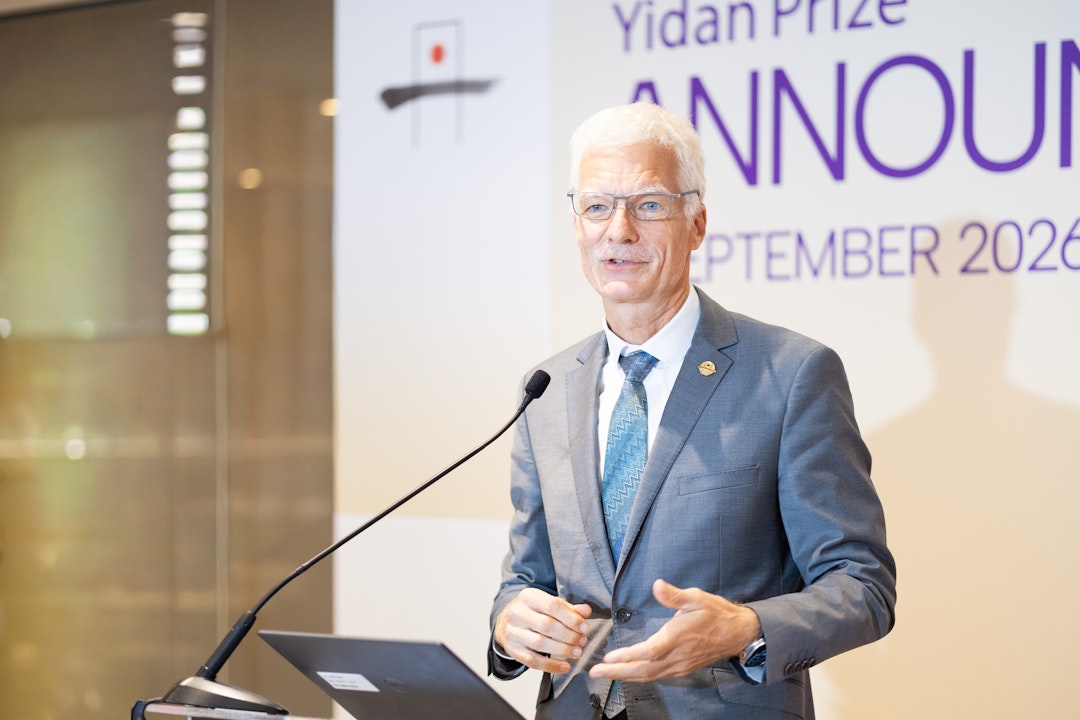
Andreas Schleicher gives a speech to welcome the 2026 Yidan Prize laureates.

02 Sep 2026

Andreas Schleicher, Chair, Yidan Prize Judging Committee

Introduction
It’s such an honor to work with the Yidan Prize team to advance the vision of Dr Charles CHEN Yidan.
And this is all so much more than a prize.
It is a shared mission, and a shared passion to make education humanity’s most powerful path to a better world.
Every year, we have the extraordinary privilege to see some of the most exciting work in education emerging around the world.
We see researchers who put forward ideas that challenge conventional wisdom and who nurture the global innovation system, which is so important if we want to create a better world through education.
We see practitioners turning ambitious ideas into transformative solutions.
And we see people demonstrating, often in the most difficult circumstances, that the future of education is in our hands.
The judging process
Our task as judges is to find that work and shine a light on it.
We look for ideas that do more than produce interesting findings or successful projects. We look for work that changes lives, strengthens communities and opens up new possibilities for our societies.
The Yidan Prize sets the bar really high. This is not just about people who improve education. Millions of people work hard on that every day. This is about people who leverage the potential of education to create a better world, a world
- in which people can live with themselves,
- can live and thrive with people who are different from them,
- and who can live with this planet, better reconciling the future with the present than my generation was able to do.
And then, through the support, the community and the platform that surround the Yidan Prize laureates, we work to help those ideas travel further — from one classroom to thousands, from one community to a country, and from countries to the world.
That is why I like to think of the Yidan Prize as the lighthouse for global education.
A lighthouse does not tell you where to go.
But it illuminates what is possible.
It helps us look beyond the horizon.
And it gives us confidence that there are new routes ahead.
Global reach
Importantly, we believe those new routes can begin anywhere.
Great ideas do not carry passports.
Innovation does not belong to one country, one institution or one part of the world.
That is why we place no limits on nominations, neither by theme nor by geography.
Instead, we ask hard questions.
Is the work pointing to the future?
Is it genuinely innovative?
Can it transform education rather than just improve it?
And can that transformation endure and travel over time and beyond locality, is the work scalable and sustainable?
The laureates
This year, once again, the answers came from across the globe.
We received nominations from six continents, including many regions that have historically been underrepresented in global education conversations.
And that matters.
Because if we want to find the future of education, we need to look for it everywhere.
We have been particularly encouraged this year by a 20% increase in new nominations for the Education Development Prize, and by the growing number of nominations from Latin America and Asia, and nominations from Africa have also remained strong.
Behind every one of those nominations is a story.
A problem someone refused to accept.
A question someone was determined to answer.
An idea someone had the courage to test.
And a group of people who believed education could not just be better but different from what it is today.
So choosing just two laureates from such an extraordinary range of work is never easy.
It is both a challenge and an enormous privilege.
And that brings me to the moment you have all been waiting for.
I am delighted to introduce the individuals whose work resonated so powerfully throughout this process — our 2026 Yidan Prize laureates.
Please join me in warmly congratulating Paul Glewwe as the recipient of this year’s Yidan Prize for Education Research.
Paul W. Glewwe is a Professor in the Department of Applied Economics at the University of Minnesota. For nearly forty years, Paul has been one of the world’s most influential researchers working on education. He helped move education policy from intuition to evidence, from a focus on how long students study and from where they graduate, to what they are actually learning. He pioneered rigorous evaluations that showed governments which interventions work, which do not, and where scarce resources can have the greatest impact.
Paul dedicated his work to a question that is central to the Yidan Prize: what actually helps children learn and thrive in a changing world.
And what makes his work truly transformative is that he helps us step back from looking just at what’s happening in classrooms, to seeing the bigger picture of success in education, from family resources and social support, through the coaching of teachers, up to the eyeglasses children may be missing to see what’s on the whiteboard.
In the same way, he helped policymakers see that the future of our economies doesn’t just live on academic outcomes, but needs people who also have strong social and emotional capabilities. This makes his work truly future-oriented.
Paul’s work is sustainable because his influence is embedded not in a specific program, but in the way countries measure poverty, design policy, evaluate reform, and increasingly value the broader skills young people need for their future, rather than just our past.
Then please join me in warmly congratulating Drs. Sally Grantham-McGregor, Susan Walker, and Susan Chang-Lopez as the recipients of this year’s Yidan Prize for Education Development. Their work began with a simple but transformative insight: if we want to change the trajectory of education, we can’t wait until children arrive at school.
Their landmark research showed that early learning and strong caregiver-child interaction can fundamentally alter the life chances of disadvantaged children throughout their lives.
At a time when the early childhood field largely focused on nutrition and health, they broadened the perspective, they put in focus that learning begins at birth, and that the foundations of learning are built in homes, in relationships, in conversations, through play.
But, and this is the key, they didn’t stop there. They turned science into action, and that is really what the Yidan Prize for Education Development is about.
Through Reach Up, their ideas have now reached children across 21 low- and middle-income countries. Their model is so innovative because it is powerful without being expensive: simple materials, culturally adapted activities, and local caregivers become the engines of development. It is transformative because its effects endure — into education, into employment, and into health. And it’s sustainable because it builds capacity in families and communities rather than creating dependence on complex institutions.
So, my congratulations again.
What comes next
Today we recognize what these laureates have already achieved.
But just as importantly, we celebrate what may come next.
Because these Yidan Prize Laureates are becoming part of a remarkable community of people who share not necessarily the same ideas, but the same determination to create a better world through education.
The 2026 laureates will bring new perspectives.
They will challenge our thinking.
They will create new connections and collaborations.
I know I speak for the whole Yidan Prize community when I say how much we look forward to learn more from these Laureates,
- working alongside them,
- celebrating their outstanding achievements at the 2026 Yidan Prize Awards Ceremony this December in Hong Kong,
- and seeing how their work contributes to creating a better world through education.
Congratulations again, and welcome to the Yidan Prize family.

Share the blog with others


