19 Jul 2026
-
21 Jul 2026
(GMT+9)

Yonsei University
About the event
Recordings
Program
Ten years ago, the world paused and took notice when AlphaGo defeated world champion Lee Sedol in Seoul. It was a significant milestone in the field of artificial intelligence and machine learning — sparking both hope and fear for the future of humanity.
Since then, the rapid rise of generative AI has led many to redirect their focus on capabilities less likely to be replaced by machines. This conversation subtly began to shift once again at the 2025 Yidan Prize Conference, when Professor Andrew Maynard invited us to reflect on the bigger question of what it means to be human and to radically rethink our approach to education.
AI is changing how we work, learn, and organize our lives. Tasks long considered the key to academic success — memorization, routine problem-solving, and structured reasoning — are now increasingly automated. In an AI-accelerated world, our ability to build trust, bridge differences, resolve conflict, and make meaning collectively underpins the future of learning and education.
In the same hotel where the defining Go match took place, Professor Ju Ho Lee, former Deputy Prime Minister and Minister of Education of South Korea, kicked off a three-day convening centred around human connection. Co-hosted by the Yidan Prize Foundation and Yonsei University alongside the 2026 International Psychometric Society Meeting, the ‘Yidan Prize Conference Series – Seoul edition’ brought together leaders across domains and sectors to learn from one another and co-create pathways towards a future grounded in relational intelligence.
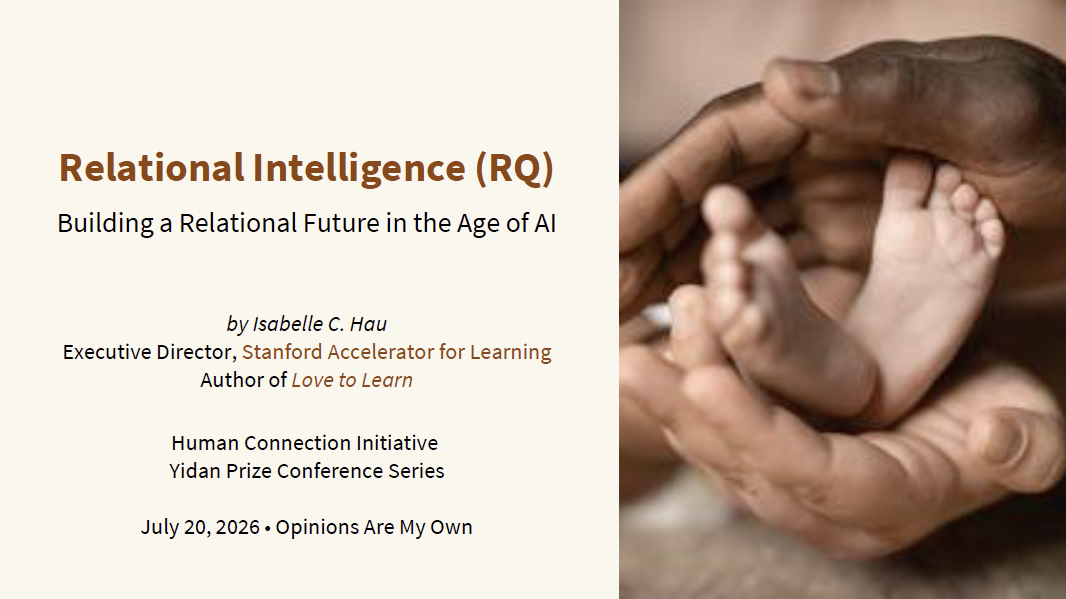
Decades of research have shown that strong relationships predict happier, healthier lives. Building on the concept of ‘relational intelligence' coined by Isabelle Hau of Stanford Accelerator for Learning, the conference explored how we can better understand, measure, and nurture relational capacity at the individual, community, and systems levels.
Over three days in Seoul, experts engaged in cross-disciplinary sharing, workshops, and consensus-building activities, laying the foundation for future studies and practical application in the classroom and beyond. Drawing from experiences across global education, public health, policymaking, psychometrics, and evaluation, we examined four key questions:
Recommended by Isabelle Hau